Leinen reveals the real reason the Meyer investigation was terminated
The Collini CaseCaspar Leinen’s cross-examination of Dr Schwan overturns the apparent meaning of the earlier proceedings against Hans Meyer: Meyer was not cleared after a finding that his wartime actions were lawful, but escaped further investigation because the statute of limitations had taken effect. By tying that procedural outcome to the 1968 Introductory Act to Administrative Offences, Leinen reveals why Fabrizio Collini’s complaint produced no judgment on Meyer’s guilt or innocence—and makes the history of that legal closure central to Collini’s motive in the murder trial.
The hearing turns
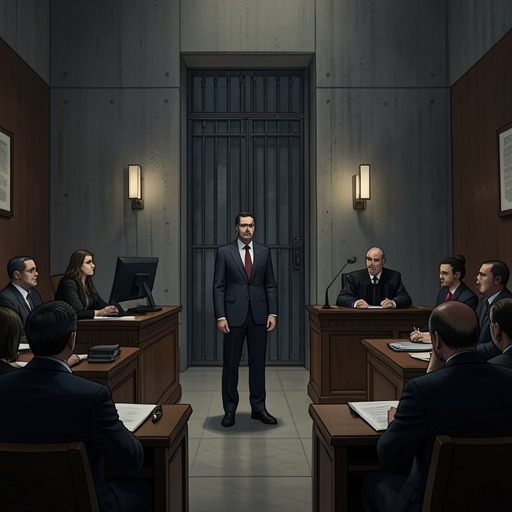
Dr Schwan had testified that the criteria for a legitimate shooting of hostages were met. The file contained reports of the shooting of the partisans in three local newspapers, which Richard Mattinger presented as satisfying the basic principles of international law. He then asked whether legal proceedings had ever been taken against Hans Meyer. The answer was yes, but Meyer had not been questioned. Mattinger drew the courtroom’s attention to the apparent contradiction: proceedings had been initiated by the Stuttgart Public Prosecutor’s Office, an investigation and file existed, yet Meyer had neither been charged nor condemned. He then established that the proceedings had been discontinued, and named 7 July 1969 as the date the Stuttgart office dropped its investigation.
Mattinger treated the testimony as a victory. Since Dr Schwan had described Meyer as meeting the criteria for a legitimate shooting, the discontinuance could appear to confirm that the killing was legally justified. Mattinger had no further questions, and the judge adjourned for lunch. Fabrizio Collini sat with his head bowed and his hands in his lap, shedding tears. The emotional response follows a courtroom account in which a file and a procedural outcome seem to have closed the question of responsibility without a trial of Meyer.
After the recess, the court was preparing to discharge Dr Schwan. The judge thought the defence had no questions, and Mattinger began to object when Leinen interrupted to say that he did. His voice had lost its earlier softness. Rather than let the discontinuance stand as an implication of lawful conduct, he asked who had brought the charges against Meyer. Dr Schwan identified Collini. The answer startled a judge; no one in the courtroom had known it, and Mattinger’s face paled. The disclosure changed the meaning of Collini’s place in the case: he had not merely killed Meyer, but had previously gone to the authorities with an accusation against him.
Collini’s complaint and the limits of the record
Leinen made Dr Schwan confirm that the question concerned the same discontinued proceedings Mattinger had raised before lunch. He then asked directly whether the Stuttgart Public Prosecutor’s Office had discontinued them because the shooting of the partisans was legitimate. Dr Schwan said no. Leinen’s show of surprise echoed the courtroom’s, but he knew the answer; he had to lead the witness through the distinction so that the others could understand what the discontinuance did and did not establish.
Dr Schwan explained that Meyer had been in command, but that no further investigation into his guilt or innocence had followed the discontinuance. The reason was the statute of limitations. Leinen then set out the sequence from Collini’s point of view: Collini identified the man who had his father shot, laid charges, provided the evidence, and trusted the authorities. A year later, he received a single sheet of paper saying that proceedings had been discontinued because the matter was time-barred. Dr Schwan confirmed that the time bar resulted from a law that came into force on 1 October 1968.
That account sharply separates filing a complaint from receiving a substantive decision. The authorities’ earlier investigation did not culminate in a finding that Meyer was innocent, and the discontinuance did not establish that the shooting was lawful. The limitation rule prevented the case from proceeding. Leinen’s questions therefore expose the gap between the official act of closing a file and the unresolved historical question that had led Collini to file it in the first place.
The 1968 law and its consequences
Leinen challenged Mattinger’s suggestion that the German Bundestag had simply decided to place Nazi crimes under a statute of limitations. Dr Schwan cautioned that the history was more complicated. Since 1960, crimes from the Third Reich had been subject to limitation periods, with murder cases excepted and still prosecutable. The change at issue came on 1 October 1968, when the Introductory Act to Administrative Offences was passed. The law appeared so minor that it was not debated in the German Bundestag, and its consequence was not recognized by the parliamentary deputies at the time.
Dr Schwan traced the law to Dr Eduard Dreher, who had served as Head Public Prosecutor at the Innsbruck Special Court during the Third Reich. Her account included examples of Dreher seeking the death penalty for a man who had stolen food and for a woman who had illegally bought clothing coupons; when the woman received thirteen years in prison, he still sought to have her sent to a Workers’ Educational Camp. The testimony places the law’s technical effect alongside the history of the official associated with its design, without making the courtroom exchange a complete biography of Dreher.
The change concerned the timing of the statute of limitations and the legal classification used to sentence certain accessories to murder. Under the new rule, they were treated as accessories to manslaughter instead. Once this effect was recognized, the affected crimes were already beyond prosecution. Dr Schwan said that the legal administration departments of the eleven Federal states, parliamentary deputies, and legal committees had all failed to detect the consequence in time; the press exposed the scandal only after the opportunity to prevent it had passed.
The consequence extended beyond Meyer’s case. Preparations were under way in Berlin for major proceedings against the head office of Reich Security, but the change meant that officials who had organized massacres in Poland and the Soviet Union could no longer be called to account. Dr Schwan described the result as an amnesty affecting a broad range of perpetrators. Leinen’s line of questioning thus links Collini’s individual experience—a complaint ending without adjudication—to a legal mechanism that obstructed wider prosecution of crimes from the Nazi era.
The defence turns procedure into history
Mattinger objected that Leinen was turning a criminal trial into a history lecture and argued that the court was trying Collini, not the legislators. Leinen answered that the law’s history mattered to the question of guilt: Collini had killed a man, but there was a difference between an arbitrary act and one that could be understood in light of what had happened to his complaint. The presiding judge allowed the inquiry because it bore on motive and could influence the question of guilt. Her ruling gave the historical explanation a direct procedural purpose; it was not simply background added to the hearing.
The exchange also exposes the limits of the apparent legal resolution Mattinger had presented. His account connected the expert’s description of a legitimate shooting to the later discontinuance, allowing the latter to sound like confirmation of the former. Leinen separates those propositions. The shooting’s reported public notice and the asserted criteria for a legitimate hostage shooting were one issue; the reason Meyer’s investigation ended was another. Dr Schwan’s answer established that limitation, not a finding about Meyer’s guilt, caused the discontinuance.
In January 2012, a few months after the novel’s original German publication, the Federal Minister of Justice appointed a committee to reappraise the Nazi past’s mark on the Ministry of Justice. The novel itself was one of the committee’s points of reference. That later consequence echoes the courtroom scene’s movement from a single discontinued investigation toward institutional history: a legal file can be closed while the questions it leaves unanswered remain available for public examination.